The engine your answers stand on.
Every insight, report and alert is only as good as the data underneath. That's why most of our engineering goes where you can't see it — and why we show you the verification results anyway.
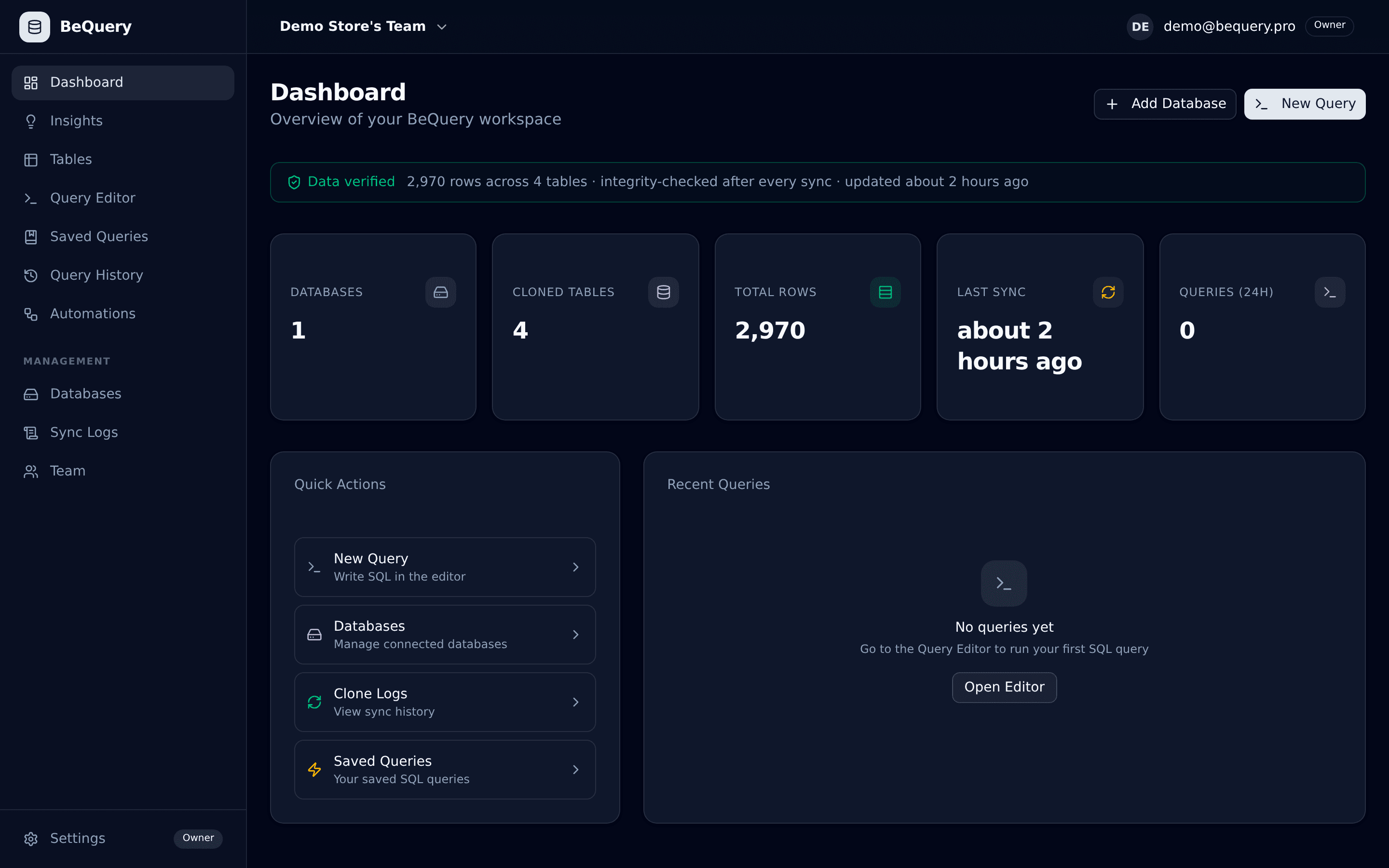
How it works
Copy that can't drift
Tables are copied by primary-key ranges (keyset), not offsets — so orders arriving mid-copy can't duplicate or skip rows. No-key tables copy inside a consistent snapshot.
Verify after every sync
The engine re-checks the clone against what it recorded as synced — row counts, missing tables, silent shortfalls — and stores the verdict you see on your dashboard.
Self-heal, then tell us
A unique index makes duplicates physically impossible to serve; if anything ever slips through, it's repaired automatically and our operators are alerted.
Always-on dedicated infrastructure
Syncs run on dedicated always-on machines, not time-limited cloud functions — even a 100M-row full re-clone completes in a single uninterrupted pass, fast and predictable.
Your choice: incremental or full
Per connection, pick incremental (only what changed — light on your store) or full (everything re-copied each run). A one-off Full Resync button rebuilds the clone on demand.
Why teams use it
- 108M-row production clone re-syncs nightly in ~28 minutes
- Weekly, daily, hourly or near-real-time (~1 min) per plan
- Missed schedules are caught up automatically within the hour
- Verification status is on your dashboard — trust, but verify
Common questions
Does syncing load my production database?
The sync reads with bounded batch sizes over a single connection — comparable to one careful employee browsing, not a crawler. And it's the only thing that ever touches production: all analytics run on the clone.
What happens if a sync fails?
It picks up again automatically from where it left off — syncs run on dedicated always-on infrastructure, with checkpointing as a safety net. If a scheduled run is missed entirely, a catch-up mechanism starts it within the hour. Failures and integrity anomalies alert our operators directly.
MySQL is 5.7/8.x — and my types?
Every MySQL type is mapped to its PostgreSQL equivalent automatically, including the awkward ones (zero-dates, ENUMs, unsigned BIGINTs).
More of BeQuery
Try it on your store's data
Free tier, no credit card, setup in 5 minutes. Your production database is never touched.
Start free